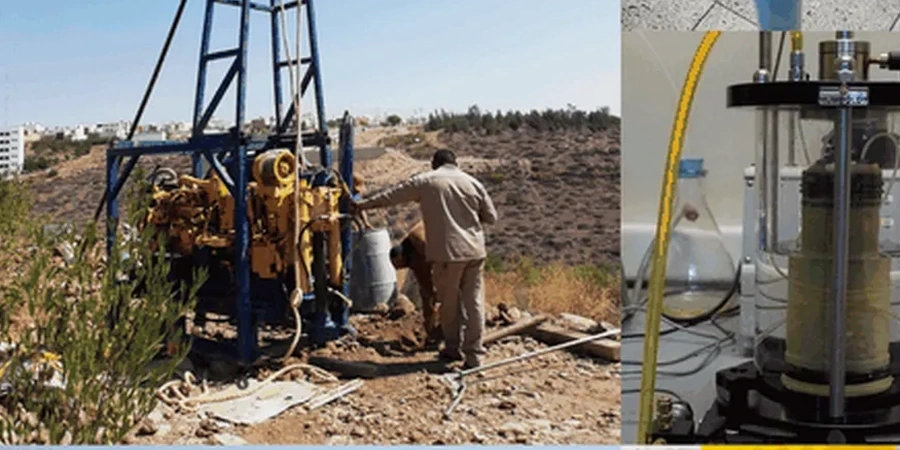
Saint-Hyacinthe's expansion from a modest seigneurial settlement along the Yamaska River into a major agri-food and logistics hub owes much to its strategic position on the St. Lawrence Lowlands. The flat terrain that simplified rail and highway construction conceals a more complex subsurface: thick sequences of post-glacial Champlain Sea clays and silts deposited roughly 12,000 years ago when the region lay submerged beneath the Atlantic's inland reach. These sensitive marine clays, locally prone to sudden strength loss when disturbed, demand a soil mechanics study that goes beyond standard borings. Understanding the deposit's preconsolidation pressure, salinity profile, and remolded strength becomes essential before placing footings or designing deep foundations for the industrial buildings rising along Autoroute 20. Our laboratory in Saint-Hyacinthe processes undisturbed Shelby tube samples for oedometer and triaxial testing, delivering the parameters structural engineers need to model long-term settlement with confidence. The triaxial consolidated-undrained tests we run often reveal effective friction angles between 22° and 28° in the intact clay crust, values that shift significantly if the weathered upper layer is mistaken for the intact material below.
Champlain Sea clay in Saint-Hyacinthe can lose up to 90% of its undisturbed strength when remolded, a sensitivity that governs excavation stability and foundation performance.
Process and scope
The contrast between the Douville district on the higher terraces east of the Yamaska and the lower-lying La Providence sector near the river illustrates why one geotechnical profile cannot serve a whole city. Douville sits on a thin veneer of till overlying shale bedrock at depths of 6 to 10 meters, yielding refusal during SPT drilling relatively early—a favorable condition for spread footings. La Providence, by contrast, exposes 25 to 35 meters of soft silty clay with undrained shear strengths often below 40 kPa in the upper 5 meters. A soil mechanics study here must quantify not only bearing capacity but also the magnitude and time rate of consolidation settlement, which can exceed 50 mm under moderate loads if not properly addressed. Sampling at 1.5-meter intervals through the clay and performing incremental load oedometer tests allows us to construct a compression curve tailored to the actual stress history at the site. Parameter selection draws on both the in-situ vane shear values and laboratory index properties, cross-checked against the empirical correlations published by Leroueil and others for Eastern Canadian clays.
Reference standards
NBCC 2020 – Division B, Part 4 for structural design and foundation requirements, CSA A23.3:19 – Design of concrete structures, Annex D for anchorage and embedment, ASTM D2435/D2435M – Standard Test Methods for One-Dimensional Consolidation Properties of Soils, ASTM D4767 – Standard Test Method for Consolidated Undrained Triaxial Compression Test for Cohesive Soils, BNQ 2501-092 – Soils — Determination of the Undrained Shear Strength by the Field Vane Test
Common questions
How long does a full soil mechanics study take for a medium-sized commercial lot in Saint-Hyacinthe?
The typical timeline runs four to five weeks from mobilization to final report delivery. Drilling and sampling on site usually require two to three days depending on access and the number of boreholes. Laboratory consolidation tests on Champlain Sea clay demand a minimum of 10 to 14 days per specimen because each load increment must be held until primary consolidation is complete. Triaxial testing adds another week. The report drafting and parameter correlation phase, including settlement calculations, takes the final five business days.
What is the approximate cost of a soil mechanics study in Saint-Hyacinthe?
For a typical commercial or light industrial building lot requiring two boreholes to depths of 15 to 20 meters with Shelby tube sampling, consolidation tests, and triaxial testing, the study generally falls between CA$4,860 and CA$7,190. The exact cost depends on the number of samples tested, the depth to bedrock, and whether specialized tests such as salinity profiling or cyclic triaxial are requested. The price includes the drilling crew, laboratory testing, and the signed engineering report.
Does the sensitive clay in Saint-Hyacinthe require special sampling techniques?
Yes. The Champlain Sea clay loses significant strength if disturbed, so we use thin-walled Shelby tubes pushed with a constant-rate hydraulic system rather than driven by hammer. The tubes are immediately sealed with wax and stored upright at field temperature during transport to the laboratory. Extrusion is done with a hydraulic extruder against a low-friction piston to minimize sample disturbance. For critical projects, we sometimes complement Shelby sampling with the Nilcon field vane to obtain a direct in-situ undrained strength before any sample stress relief occurs.
What parameters do structural engineers most commonly request from the report?
The core parameters requested are the undrained shear strength profile with depth, the preconsolidation pressure and compression index from oedometer tests, the effective friction angle from CIU triaxial, and the modulus of elasticity for immediate settlement calculations. For projects involving excavations, the remolded strength and sensitivity are added. The report also provides a recommended allowable bearing pressure at the proposed foundation elevation, accounting for the NBCC 2020 safety factors applied to the ultimate bearing capacity calculated using the general shear failure equation.