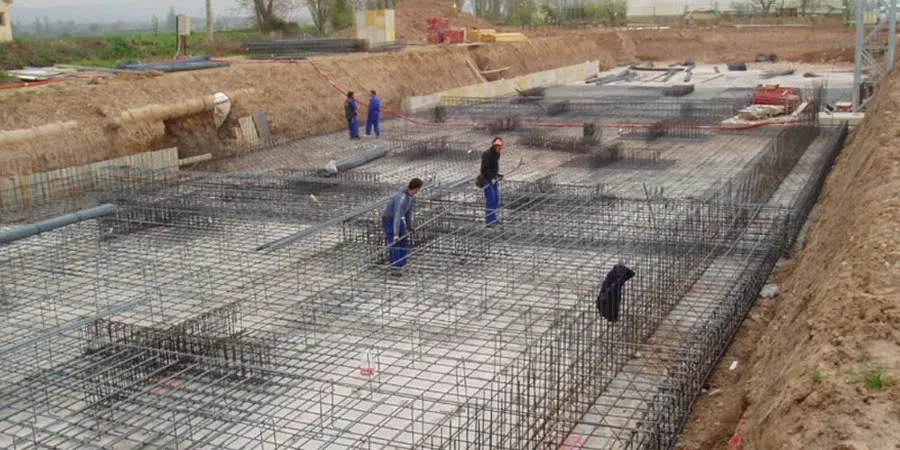
A foundation designed for the compact tills near the Saint-Hyacinthe city center behaves nothing like one placed in the soft alluvial clays that stretch out toward the Yamaska River's floodplain. This contrast, just a few kilometers apart, defines the challenge of shallow foundation design in this region. The Douville sector often surprises builders with dense glacial deposits at shallow depth, while areas closer to the river corridor demand a more cautious approach to bearing capacity and differential settlement. Our team has spent years correlating the agricultural capital's surface geology with reliable shallow foundation solutions, ensuring that every footing and mat rests on a thoroughly characterized stratum. A preliminary spt-drilling investigation often reveals these critical transitions before the first shovel hits the ground.
Saint-Hyacinthe's Champlain Sea clays can lose half their strength when remolded; a shallow foundation must never be designed from a single borehole log.
Process and scope
Saint-Hyacinthe's urban fabric expanded rapidly after the 1850s, when the Grand Trunk Railway turned it into a commercial hub. Much of the historic core was built over lacustrine deposits that have been compacted by a century and a half of successive construction, yet the peripheral zones, where the newer industrial parks sit, often hide lenses of organic silt from the ancient Champlain Sea. This patchwork of subsurface conditions makes shallow foundation design in Saint-Hyacinthe a site-specific exercise, not a generic application of code tables. We verify in-situ density with nuclear gauge tests and correlate results with laboratory grain-size analysis from Shelby tube samples. The CSA A23.3 concrete standard requires that foundation subgrades meet strict deformation criteria, and our field team documents every layer to confirm that the bearing stratum aligns with the geotechnical model before formwork begins.
Local geotechnical context
A six-story residential project on Rue des Cascades taught us a lesson we don't forget. The initial borehole suggested stiff clay at two meters, but a second probe thirty meters east hit a buried channel filled with loose silt and wood debris, a remnant of the old Saint-Hyacinthe millrace. Had the shallow foundation design relied on that first optimistic log, the differential settlement would have cracked the structure within three freeze-thaw cycles. This is the risk profile of the Richelieu basin: lateral variability is the rule, not the exception. The 2020 NBCC imposes a serviceability limit state of 25 mm for footings on clay, a threshold that demands conservative bearing pressures and rigorous inspection. We mitigate this by pairing cone penetration tests with hand-auger checkpoints, building a three-dimensional picture of the subsurface before selecting the final footing geometry.
Common questions
What is the typical cost range for a shallow foundation design in Saint-Hyacinthe?
For a standard single-family home or small commercial building, the geotechnical investigation and foundation design typically range from CA$2,460 to CA$4,910. The final figure depends on the number of test pits or boreholes required, the complexity of the soil profile, and the structural loads. We deliver a fixed-price proposal after reviewing the architectural plans and the specific lot location.
How deep do footings need to be in Saint-Hyacinthe to avoid frost heave?
The Quebec building code mandates a minimum frost protection depth of 1.4 meters in the Saint-Hyacinthe region. We typically specify footing bases at 1.5 meters below the exterior finished grade to deliver a safety margin against the frost front, especially under unheated structures like garages or entry canopies.
What if my site has soft clay? Can I still use a shallow foundation?
It depends on the thickness and consistency of the soft layer. If the Champlain Sea clay is limited to the upper meter or so, we can often excavate it and replace it with engineered granular fill compacted in lifts. For thicker deposits, a mat foundation or ground improvement with stone columns may be more appropriate, and we will recommend the option that balances performance with cost.
Do you coordinate with the structural engineer and the city of Saint-Hyacinthe?
Yes, completely. We deliver a sealed geotechnical report with the bearing capacity and foundation recommendations, which you submit to the City of Saint-Hyacinthe's urban planning department as part of the building permit application. We also collaborate directly with your structural engineer to align the footing design with the reinforcement and column loads.