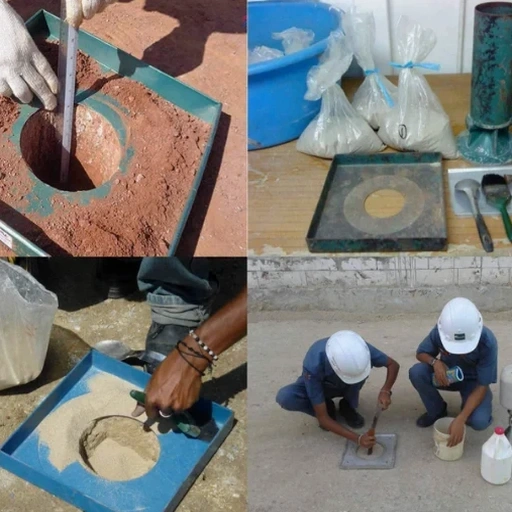
The most common mistake we see on Saint-Hyacinthe job sites is assuming that visual inspection confirms proper compaction. It does not. The silty-clay deposits that extend across the Yamaska River plain can look firm at the surface but hide poorly compacted lifts underneath. A single heavy rainfall, typical of a Saint-Hyacinthe summer, and those voids reveal themselves through differential settlement. The field density test with the sand cone method eliminates that guesswork. It provides a direct measurement of in-place density that correlates to Proctor values, giving the site supervisor a clear pass-or-fail result before concrete is poured or asphalt is laid. For road crews working along Route 137 or foundation contractors in the newer subdivisions east of the city center, this test is the difference between a structure that performs for decades and one that develops cracks in the first freeze-thaw cycle.
Compaction verified with the sand cone method is still the most defensible QC data you can hand to a Saint-Hyacinthe building inspector.
Local geotechnical context
A paving contractor on Rue Dessaulles completed a parking lot sub-base in late October. The weather turned cold fast, and the crew skipped the field density test to stay on schedule. By February, the freeze-thaw action had heaved the poorly compacted granular layer, creating depressions that held water and ice. The spring repair cost exceeded two weeks of profit on the job. On silty soils like those in Saint-Hyacinthe, compaction is never something to assume. The sand cone test gives you a number: a dry density value and a relative compaction percentage. If it is below spec, the fix is straightforward now, backfill and recompact. If you skip it and the problem shows up after the pavement is down, you are looking at saw-cutting, removal, and full-depth patching. The test is cheap insurance.
Common questions
How much does a sand cone density test cost in Saint-Hyacinthe?
Field density testing with the sand cone method in Saint-Hyacinthe typically ranges from CA$120 to CA$180 per test location, depending on the number of tests per mobilization and site access conditions. A full day of QA/QC testing on a subdivision project includes multiple test locations and the corresponding report. Contact us for a quote tailored to your project spec.
How soon can you mobilize a technician to a site in Saint-Hyacinthe?
For projects inside Saint-Hyacinthe city limits, we can usually have a technician on site within 24 to 48 hours of receiving a request. We keep Ottawa sand and calibrated equipment ready in our vehicles so there is no prep delay on our end.
What compaction standard do you test against?
We test against Standard Proctor (ASTM D698) or Modified Proctor (ASTM D1557), whichever is specified in the project geotechnical report. For most residential slabs and landscaping subgrades in Saint-Hyacinthe, 95% Standard Proctor is the common requirement. Road base specifications often call for 98% Modified Proctor.
Can you test under wet conditions after rain?
The sand cone method can be run on damp soils, but standing water in the test hole will affect accuracy. After heavy rain in Saint-Hyacinthe, we typically wait for the surface to drain and the soil to reach a workable moisture condition. If the schedule is tight, we can assess the site and determine whether a speedy moisture correction will keep the results reliable.