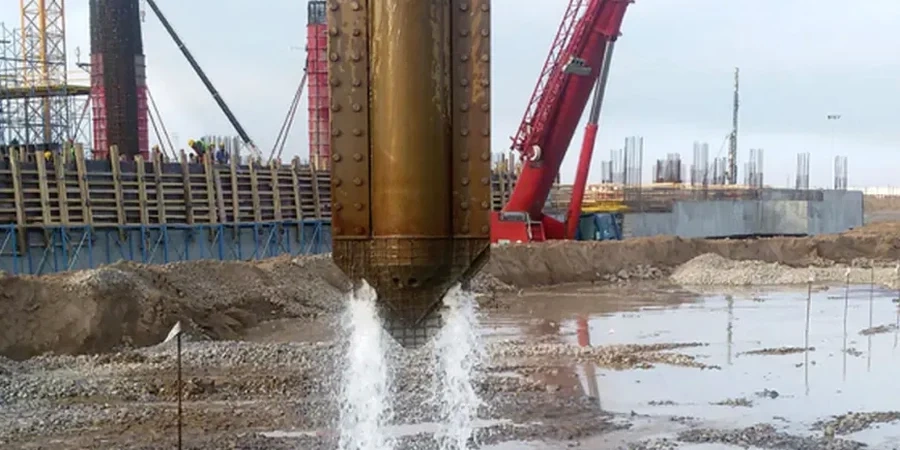
The alluvial plains of the Yamaska River define Saint-Hyacinthe’s subsurface, where loose sands and silty deposits are common beneath industrial parks and agri-food processing plants. The city’s 45.6275°N latitude brings freeze-thaw cycles that can exacerbate settlement in uncompacted fills, a reality that demands a solid stone columns approach when granular soils are too fine for vibratory methods alone. For coarse, free-draining materials, however, vibrocompaction design remains the fastest path to a densified bearing stratum. The local water table, typically found within 3 to 5 meters of the surface, requires careful control of saturation during the compaction process, which is why our technical team integrates CPT testing before and after treatment to verify that relative density targets have been met across the entire treatment zone. The 2020 version of the NBCC, adopted across Quebec, sets clear seismic and bearing requirements that make deep compaction a critical step for any structure founded on the region’s glaciofluvial deposits.
In Saint-Hyacinthe’s alluvial plain, achieving 70% relative density below the water table requires real-time power monitoring and a grid calibrated to the local grain-size curve.
Local geotechnical context
Saint-Hyacinthe sits within a moderate seismic zone, and the NBCC 2020 assigns a spectral acceleration Sa(0.2) of approximately 0.45 g for the region. Loose saturated sands below the water table carry a real liquefaction potential during a design earthquake, a risk that Seed and Idriss’s simplified procedure quantifies through factor of safety calculations based on CPT tip resistance. Skipping vibrocompaction on a granular site can leave the soil in a contractive state, where cyclic loading triggers excess pore pressure and sudden strength loss. Beyond seismic concerns, differential settlement under heavy silo loads or processing equipment leads to structural cracking and misalignment of conveyor systems, a costly outcome in the food-processing sector that dominates the local economy. A properly designed vibrocompaction grid, verified by post-treatment liquefaction analysis, eliminates both the settlement and the cyclic mobility hazard in one operation.
Common questions
What grain-size range works best for vibrocompaction in Saint-Hyacinthe?
The method is most effective in clean sands with fines content below 12 percent. The Yamaska plain often contains silty layers; we run a full grain-size distribution before design. If fines exceed 15 percent, stone columns or a mixed grid typically produce better results.
How much does a vibrocompaction design package cost for a typical site here?
Design fees for a standard industrial lot in Saint-Hyacinthe range from CA$1,920 to CA$7,320, depending on the treated area, depth, and the verification testing scope. This includes pre-treatment CPT, grid design, specification writing, and post-treatment SPT or seismic verification.
How do you verify that the compaction worked?
We run a statistically defined number of post-treatment CPT or SPT soundings on a grid offset from the compaction points. The target is typically 70 to 85 percent relative density, confirmed by correlations like Baldi or Jamiolkowski that link tip resistance to Dr for the local sand.
Does vibrocompaction address the freeze-thaw problem in Saint-Hyacinthe?
Freeze-thaw affects the upper 1.5 to 2.0 meters. Vibrocompaction densifies deeper deposits, which remain below the frost penetration zone. Surface protection through a compacted granular cap and proper drainage addresses the near-surface cycle.