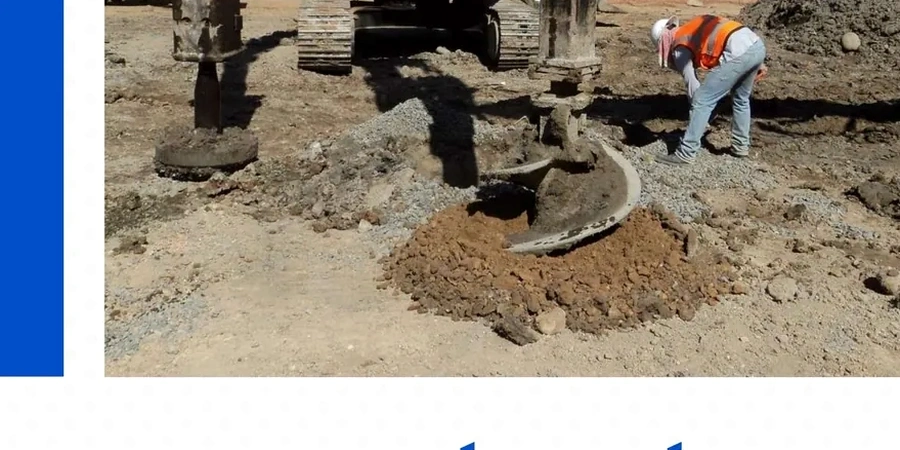
The National Building Code of Canada sets clear performance criteria for foundations on weak ground, and in Saint-Hyacinthe those criteria hit hard against the reality of post-glacial Champlain Sea deposits. Most of the city rests on a sequence of silty clays and sensitive marine sediments that lose strength when disturbed, which makes conventional shallow footings risky for anything beyond light residential work. We approach stone column design as a controlled ground improvement strategy, not just a load-transfer solution: column diameter, spacing, and depth are tuned to the undrained shear strength profile measured on each lot, with verification via plate load testing before structural work begins. For projects east of the Yamaska River where organics intermix with alluvial silts, we frequently pair stone columns with a mat foundation to bridge any residual differential settlement across the improved zone.
A well-compacted stone column network can reduce total settlement by 40 to 60 percent in the Champlain clays typical of Saint-Hyacinthe, provided the column length fully penetrates the compressible layer.
Common questions
How much does stone column design cost for a typical Saint-Hyacinthe project?
For sites within the Saint-Hyacinthe area, design fees generally range from CA$1,850 to CA$6,190 depending on the building footprint, the number of CPT soundings required, and whether finite element analysis is needed. A single-family residential lot on Champlain clay with a standard grid design tends toward the lower end; a multi-storey commercial building requiring load test supervision and 3D settlement modeling falls toward the upper end.
How do stone columns perform in Saint-Hyacinthe's sensitive clays during an earthquake?
Stone columns deliver two benefits under seismic loading in the sensitive Champlain Sea deposits common to the Richelieu Valley: they densify the surrounding clay during installation, reducing its void ratio, and they act as preferential drainage paths that limit pore-pressure buildup during cyclic shaking. The key parameter is the clay's sensitivity ratio (St), which we measure from undisturbed samples; when St exceeds 15, we adjust the vibration energy and probe advancement rate to minimize remolding during column construction.
What is the minimum clay thickness that justifies stone columns instead of shallow footings?
We typically start considering stone columns when the compressible clay layer exceeds 3 metres and the calculated total settlement under the design load surpasses 25 mm for conventional spread footings. In Saint-Hyacinthe, where the crust is often only 1.5 to 2 metres thick over much softer clay, this threshold is reached very quickly — most two-storey structures on the clay plain near the Yamaska River will trigger a ground improvement assessment.
Do stone columns require a load test after installation in Saint-Hyacinthe?
Yes, and we specify it in every design package. A plate load test on at least one working column per distinct soil zone, following ASTM D1143 procedures adapted for the column diameter, verifies that the actual load-settlement response matches the design curve. In the Champlain clay context, where sensitivity can vary across a single lot, skipping this step introduces too much uncertainty into the foundation performance.