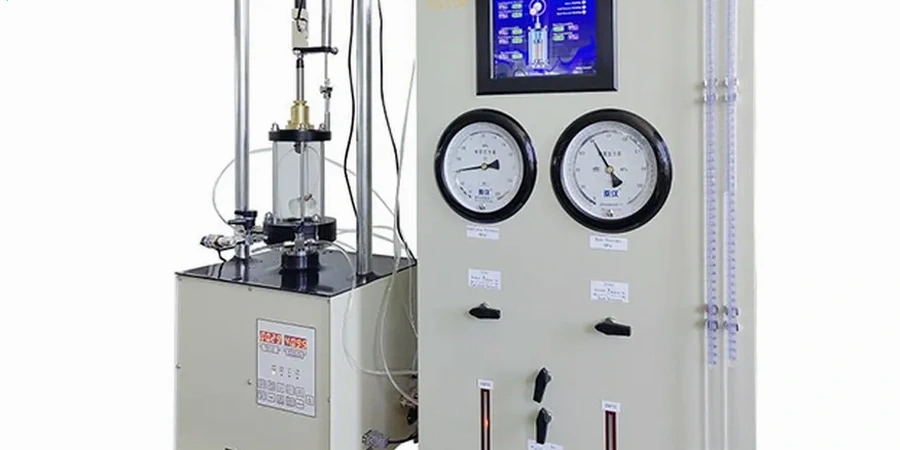
In Saint-Hyacinthe, what you see at the surface rarely tells the whole story. The city sits on the floor of the former Champlain Sea, and the marine clay deposits here can extend well below 30 metres before hitting competent glacial till. We commonly encounter sensitive silty clays in the low-lying areas near the Yamaska River that lose significant strength when remoulded. A standard penetration test gives you a blow count, but it does not directly measure the friction angle or undrained cohesion you need for a proper bearing capacity analysis under the National Building Code of Canada. That is where the triaxial test comes in. Our laboratory runs consolidated-undrained (CU) and consolidated-drained (CD) triaxial tests on Shelby tube samples extracted from Saint-Hyacinthe sites, giving you the effective stress parameters required to design deep excavations in the downtown core or assess slope stability along the riverbanks of the Yamaska. The procedure follows ASTM D4767 for CU testing, and we backpressure-saturate every specimen to achieve B-values above 0.95 before shearing.
Triaxial testing on Champlain Sea clays reveals friction angles typically between 24 and 30 degrees in the dense till contact zone beneath Saint-Hyacinthe.
Common questions
What does a triaxial test cost in Saint-Hyacinthe?
For a standard consolidated-undrained (CU) triaxial test program, you can expect a range between CA$2,380 and CA$4,270 depending on the number of specimens, confining pressures, and whether you need effective stress or total stress parameters. A single UU test on one specimen falls at the lower end, while a full CD test with volume change measurement and multiple stages sits at the upper end.
How many triaxial specimens do I need for my Saint-Hyacinthe project?
We recommend a minimum of three specimens per distinct soil layer to define a Mohr-Coulomb failure envelope. For a typical Saint-Hyacinthe site with Champlain Sea clay over till, plan on three CU specimens from the clay deposit and, if the till is sampled intact, three additional specimens from that stratum.
Can you test the sensitive clay without disturbing the sample?
Sample disturbance is the biggest challenge in Champlain Sea clays. We use thin-walled Shelby tubes and trim specimens carefully in a humidity-controlled room. Backpressure saturation with a B-check above 0.95 helps recover in-situ effective stress conditions before shearing, though highly sensitive clays may still show some strength reduction from unavoidable tube sampling effects.
What is the difference between a CU and a CD triaxial test?
A consolidated-undrained (CU) test is sheared without allowing drainage, and we measure excess pore pressure to compute effective stress parameters. A consolidated-drained (CD) test is sheared slowly enough to dissipate pore pressures, giving drained friction angles directly. For Saint-Hyacinthe clays, CU with pore pressure measurement is the most common because CD tests can take several days per specimen due to the low permeability of the clay.
How do you handle the fissured crust in the upper clay?
The oxidised crust in Saint-Hyacinthe often contains fissures and root holes that make intact specimen preparation difficult. We typically trim specimens from below this zone for triaxial testing and characterise the crust separately through field vane tests and index properties. If the crust must be tested, we use larger-diameter specimens (71 mm) to capture a representative volume that includes the fissure network.