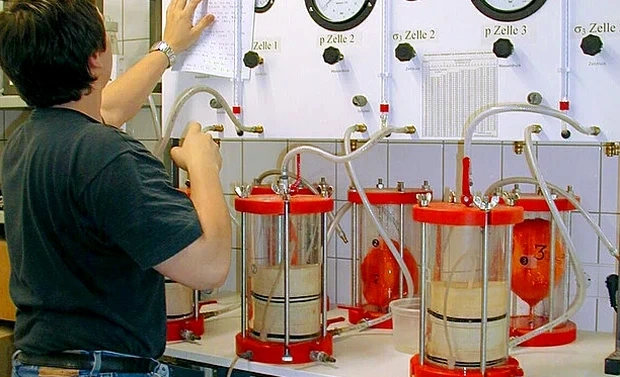
The clay plains of Saint-Hyacinthe hold moisture late into spring. That retained water in the silty-clay subgrades shifts the soaked CBR value downward by several points if it is not measured properly. When the city expanded its industrial park near the Yamaska River, the geotechnical reports showed CBR values dropping from 8% to under 3% just by saturating the sample 24 hours before the penetration test. We run the grain-size analysis first to confirm the fines fraction, then the laboratory CBR test under ASTM D1883 with a 4-day soak to replicate worst-case field drainage. The outcome is a design CBR that the pavement engineer can trust. Overestimating that number in Saint-Hyacinthe means premature rutting, edge cracking, and costly overlays within the first three freeze-thaw cycles.
A 2% CBR difference in a soaked Saint-Hyacinthe clay can cut the pavement structural number by half and double the required granular thickness.
Common questions
How much does a laboratory CBR test cost in Saint-Hyacinthe?
A single-point laboratory CBR test, including the Modified Proctor compaction curve and a 96-hour soak, typically runs between CA$180 and CA$300 per sample. The exact cost depends on the number of points and whether we are testing the subgrade alone or also evaluating the granular base course. A standard pavement design package with three CBR points, Atterberg limits, and grain-size analysis falls on the lower end of that range per test when bundled.
What is the difference between a soaked and an unsoaked CBR test?
A soaked CBR test submerges the compacted specimen in water for 96 hours before penetration, simulating the worst-case moisture condition the subgrade will track record over its service life. An unsoaked test is run immediately after compaction. In Saint-Hyacinthe's Champlain Sea clays, the soaked value often drops to 30-50% of the unsoaked number because of the high silt content and moderate plasticity. Pavement design must use the soaked CBR unless the subgrade is permanently protected from moisture ingress.
How many CBR samples do I need for a parking lot design?
For a typical commercial parking lot in Saint-Hyacinthe, three CBR samples taken from the subgrade at the proposed formation level are the minimum. If the site has variable soil conditions—such as transitions from till to alluvial clay near the Yamaska River—we recommend one sample per distinct soil unit. The NBCC and TAC pavement design guides base the granular thickness calculation on the lowest representative soaked CBR, not the average, so sampling must capture the weakest zone.