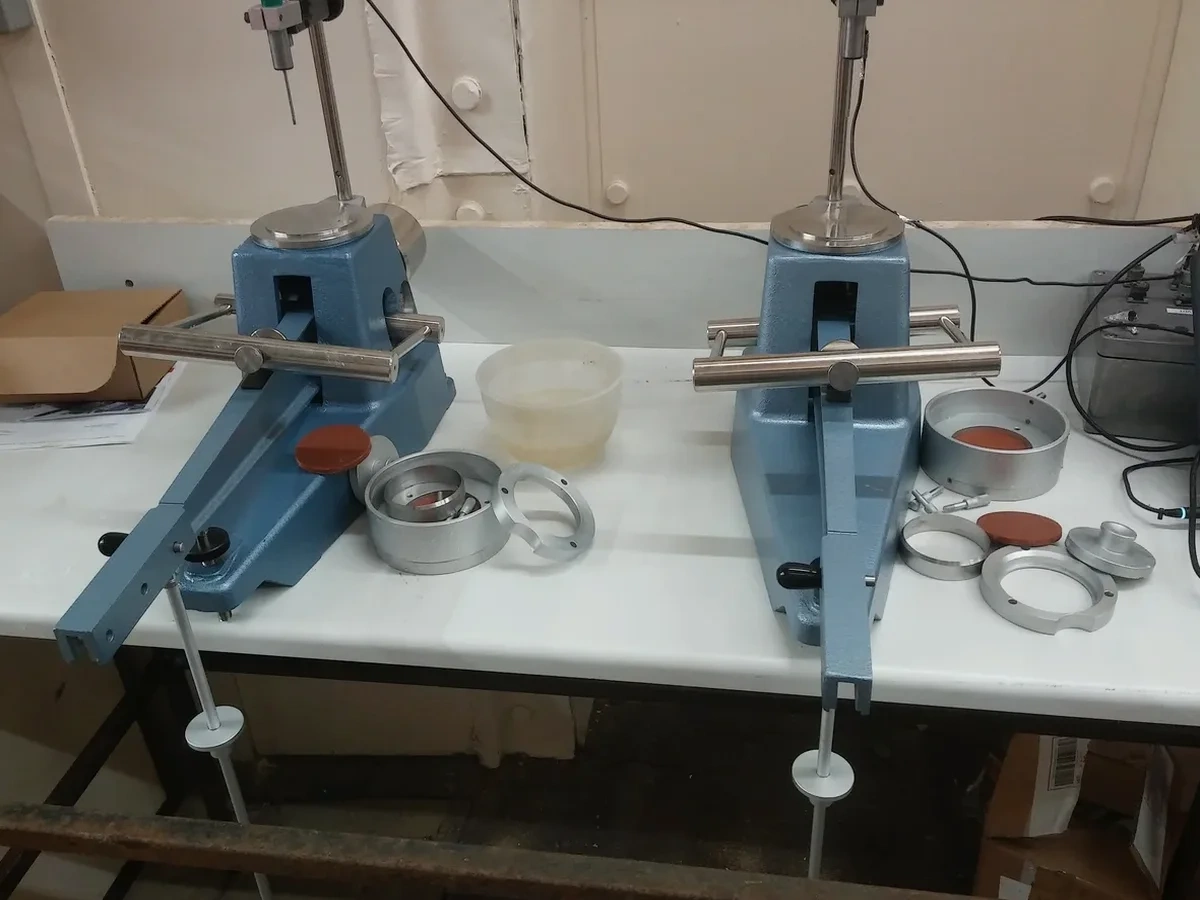
The Casagrande cup sits on a workbench in our Saint-Hyacinthe lab, its brass bowl ready to receive a paste of local clay. A technician adjusts the drop cam to exactly 10 mm, then runs the spatula through the soil 13 mm along the bottom of the cup. We count the blows until the groove closes. This is the liquid limit test, the most operator-sensitive step in the entire procedure, and it demands repetition until at least three points define the flow curve. When the material comes from a site near the Yamaska River or a new subdivision over Champlain Sea deposits, we know the plasticity data will drive foundation decisions, because the fine-grained soils here can transition from stiff to soft within a single meter of depth. For granular layers encountered in the same borehole, we often pair this work with a grain-size analysis to build a complete index profile before any structural load is applied.
A plasticity index above 30% in Champlain Sea clay means the soil will shrink and swell with every seasonal moisture cycle — ignoring that number cracks foundations.
Reference standards
ASTM D4318 – Standard Test Methods for Liquid Limit, Plastic Limit, and Plasticity Index of Soils, ASTM D2216 – Standard Test Methods for Laboratory Determination of Water (Moisture) Content of Soil and Rock by Mass, ASTM D2487 – Standard Practice for Classification of Soils for Engineering Purposes (Unified Soil Classification System), CSA A23.3 – Design of Concrete Structures (relevant for soil-structure interaction parameters derived from index tests), NBCC 2020 – National Building Code of Canada (referenced for foundation design on plastic soils)
Common questions
How much does Atterberg limits testing cost in Saint-Hyacinthe?
A standard liquid limit and plastic limit determination on one sample typically ranges from CA$90 to CA$130, depending on the number of flow curve points required and whether companion moisture content tests are included. For multi-sample projects, we deliver package pricing based on total sample count and turnaround time.
How many blow counts are needed for a valid liquid limit test?
ASTM D4318 requires a minimum of three points spanning a range of 15 to 35 blows to define the flow curve. Each point represents a separate moisture condition of the same soil paste. We typically run four or five points to improve statistical confidence, especially when the soil contains organic fibers or the flow curve shows non-linear behavior.
What is the difference between liquid limit and plastic limit?
The liquid limit is the water content at which soil transitions from a plastic state to a liquid state, measured when the groove in the Casagrande cup closes over 13 mm in 25 blows. The plastic limit is the water content where the soil begins to crumble when rolled into threads of 3.2 mm diameter. The numerical difference between them is the plasticity index, which quantifies the range of moisture over which the soil behaves plastically.
How long does the test take from sample receipt to report?
A single Atterberg limits test typically requires three to five business days, including sample preparation, testing, oven-drying, and reporting. For time-sensitive projects in Saint-Hyacinthe, we can expedite to 48 hours if we receive the sample before 10:00 AM and the soil does not require extended soaking or pretreatment.