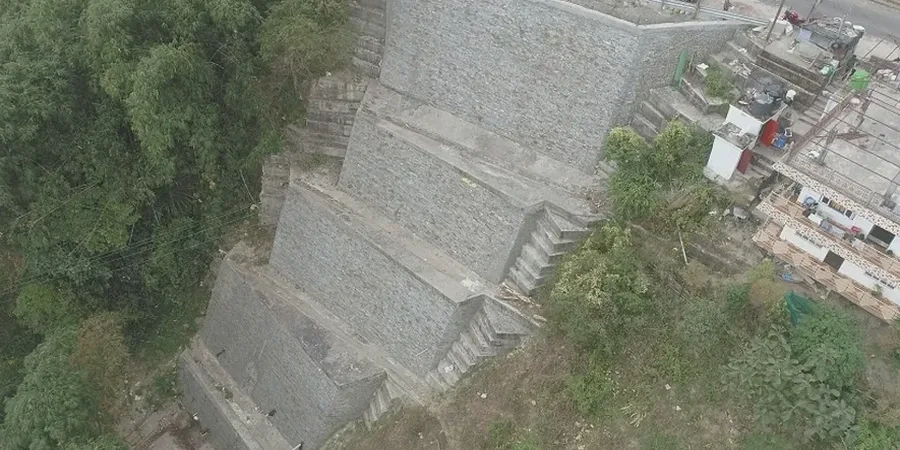
The National Building Code of Canada (NBCC) sets clear expectations for construction on or near slopes, and in Saint-Hyacinthe the local geology makes these assessments non-negotiable. The city sits within the St. Lawrence Lowlands, where thick Champlain Sea clay deposits and silty tills create complex subsurface conditions. When a project involves a cut, fill, or retaining structure, a slope stability analysis becomes the foundation of design safety. Our team has worked extensively across the Montérégie region, dealing with the sensitive clays and groundwater regimes that define this area. We combine field investigation data with limit equilibrium and finite element modeling to evaluate both short-term and long-term stability. For deeper profiles, we often integrate findings from a CPT test to map continuous stratigraphy and identify weak layers that could control the failure surface.
In Saint-Hyacinthe, a slope that looks stable in summer can be just one spring thaw away from movement if the underlying Champlain Sea clay isn't properly characterized.
Process and scope
A mistake we see too often in Saint-Hyacinthe is contractors assuming a uniform soil profile based on a single borehole, then wondering why a slope moves after heavy rain. The reality is that the Yamaska River and its tributaries have carved through layered deposits, leaving behind perched water tables and lenses of soft clay that require a detailed slope stability analysis to detect. Our approach starts with a thorough review of the site's Quaternary geology, followed by targeted field testing. We measure shear strength through laboratory triaxial testing and in-situ vane shear, then model the slope under various groundwater conditions. The analysis includes both circular and non-circular failure surfaces using Spencer and Morgenstern-Price methods. When the project involves structural support, we also reference the retaining walls design parameters to ensure the reinforced system accounts for the calculated lateral earth pressures and global stability factors.
Common questions
What does a slope stability analysis cost in Saint-Hyacinthe?
For a typical residential or small commercial project in the Saint-Hyacinthe area, a comprehensive slope stability analysis ranges from CA$1,890 to CA$4,940. The final figure depends on the slope height, required drilling depth, and the complexity of the soil profile. Projects needing advanced laboratory testing or seismic analysis will be at the higher end.
How long does it take to complete the analysis and receive the report?
After field investigation is complete, the analysis and reporting phase generally takes two to three weeks. Rush timelines can be accommodated if site access and lab scheduling permit.
Do you need to drill boreholes on my property for the analysis?
Yes, a slope stability analysis requires accurate subsurface data. We typically use a combination of test pits for shallow exploration and CPT soundings or boreholes to reach deeper materials. The number and depth of investigation points are determined by the slope geometry and local geology.
Is seismic loading considered in the stability calculations?
Absolutely. We apply the seismic hazard values from the NBCC 2020 for the Saint-Hyacinthe location and use pseudo-static analysis methods. In higher consequence projects, we can also perform a full post-earthquake deformation analysis to estimate potential displacements.