← Home · Investigation

Exploratory Test Pit Services in Saint-Hyacinthe

Together, we solve the challenges of tomorrow.

LEARN MORE →

Saint-Hyacinthe sits on the deep Champlain Sea clay deposits of the Yamaska River plain, where sensitive marine silts and soft clays often extend to depths of 20 to 30 metres before hitting glacial till. A simple borehole log can miss the lateral variability that an exploratory test pit reveals with direct visual access. Our team logs these walls in 1.5-metre lifts, identifying oxidised crusts, sand seams and the true depth of the desiccated surface layer that controls bearing capacity. For projects near the river or in the older industrial quarter, we often combine the test pit with a CPT test to correlate the tactile log with continuous tip resistance, giving the geotechnical engineer a calibrated profile without the cost of a full drilling program.

A test pit in Saint-Hyacinthe clay shows you the desiccated crust thickness directly — no core sample gives you that clarity in the Yamaska lowlands.

Process and scope

Saint-Hyacinthe winters freeze the ground to nearly 1.2 metres, and the spring thaw turns the Champlain clay into a slick, expansive paste that can heave shallow footings. An exploratory test pit lets us observe the actual moisture profile and the transition from the stiff crust to the underlying soft, grey clay before the excavation collapses. We use a hydraulic excavator with a clean-up bucket to shave vertical faces, then log according to the Canadian Foundation Engineering Manual descriptors. In low-clearance urban lots we open smaller pits and reinforce the walls with a portable trench box. When the stratigraphy shows a thin crust over sensitive clay, the log becomes a trigger for a slope stability analysis, especially for basement excavations deeper than 2.5 metres.
Exploratory Test Pit Services in Saint-Hyacinthe
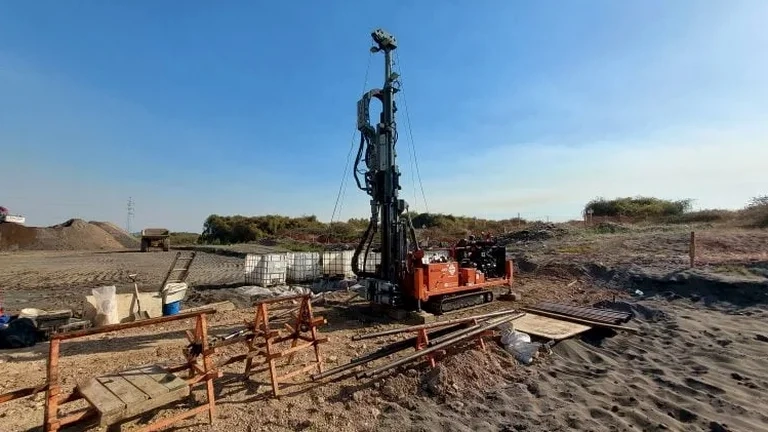
Technical reference image — Saint-Hyacinthe

Local geotechnical context

The 2015 National Building Code of Canada assigns Saint-Hyacinthe a seismic hazard index that, combined with the sensitive marine clay, makes shallow foundation design more demanding than it appears. An exploratory test pit that misses a thin sand layer within the clay can lead to a drained shear failure under cyclic loading — a condition well-documented in Seed & Idriss studies on sensitive soils. The biggest risk on a Saint-Hyacinthe site is mistaking a temporary surface crust for permanent bearing stratum. Our pit logs include vane shear tests on the pit floor and pocket penetrometer readings on the vertical face every lift, so the structural engineer has measured strengths, not just descriptions. When the pit reveals organic silt or buried topsoil, the foundation recommendation shifts immediately to a vibrocompaction treatment or a deeper bearing elevation.

Need a geotechnical assessment?

Reply within 24h.

Email: info@geotechnical-engineering.org

Technical data

ParameterTypical value
Typical depth in Champlain clay3.0 – 4.5 m
Frost penetration design depth1.2 m (NBCC Table C-2)
Wall logging interval0.5 m vertically
Bucket width for clean vertical face600 – 900 mm
Trench box deployment depth> 1.5 m (CNESST compliance)
Photo documentationFull-wall mosaic + close-ups per lift
Reporting standardCSA A23.3 / NBCC 2015

Complementary services

01

Stratigraphic logging and sampling

We open pits with a tracked excavator and log the exposed profile in 0.5-metre lifts. Pocket penetrometer and hand vane readings are taken on each lift face. Disturbed and block samples are extracted, sealed, and delivered to our accredited laboratory for index testing.

02

Backfill verification and compaction testing

For additions or remedial work, we excavate through existing fill to verify its composition and condition. We then run sand cone density tests on the pit floor or adjacent compacted lifts to confirm that backfill meets the project's relative compaction specification.

Reference standards

NBCC 2015 – Division B, Part 4, CSA A23.3 – Design of Concrete Structures (foundation provisions), Canadian Foundation Engineering Manual (CFEM) – soil description, CNESST Safety Code – excavation and trenching

Common questions

What does an exploratory test pit cost in Saint-Hyacinthe?

A single exploratory test pit in Saint-Hyacinthe typically ranges from CA$780 to CA$1,210, depending on depth, access constraints, and whether we deploy a trench box for safety. The price includes utility locates, the excavator with a clean-up bucket, full stratigraphic logging with photos, and a short report. Extra pits on the same day reduce the unit cost.

How deep is the seasonal frost line in Saint-Hyacinthe, and why does it matter for a test pit?

The NBCC Table C-2 gives a frost penetration depth of 1.2 metres for this region. We log the pit below this depth to see whether the clay structure changes once you pass the freeze-thaw zone. Footings placed in the active layer risk differential heave, so the pit log must show the competent bearing layer clearly below that 1.2-metre mark.

Do you need a structural engineer on site during the test pit?

Not necessarily, but we coordinate closely with your engineer. We send them a real-time photo log from the pit so they can direct sampling and decide when the pit has reached adequate bearing. For complex projects on the Champlain Sea clay, having the engineer walk the pit with our logger adds value, but it is not a contractual requirement.
Location and service area

We serve projects in Saint-Hyacinthe and surrounding areas.

View larger map